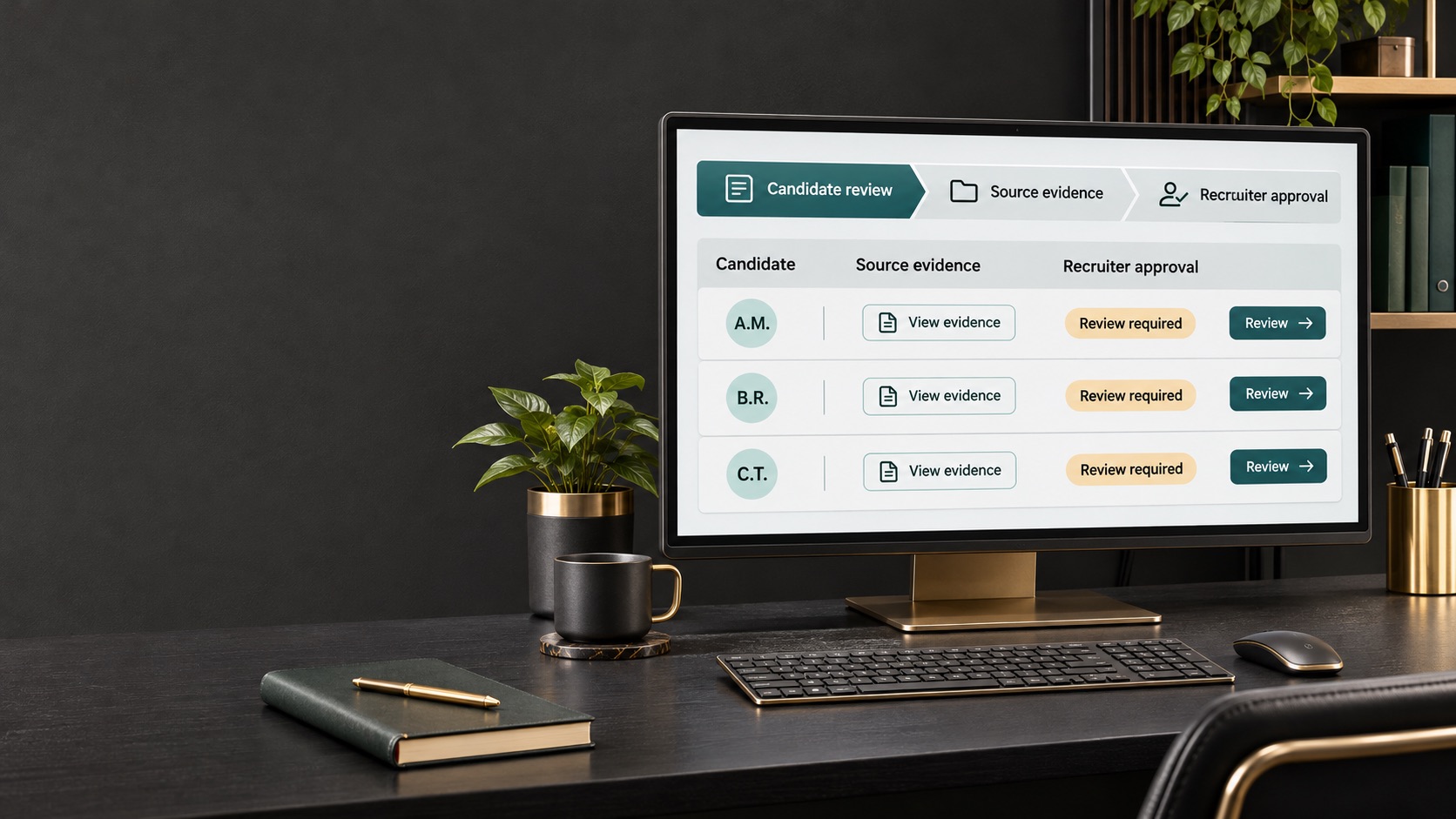
Help recruiters review applications and arrange interviews.
Example agent profile
Application review & recruiter assistance
Users
Recruiters, hiring managers and applicants
Typical tasks
Read CVs, summarize qualifications and schedule interviews
01
Read the application
The submitted CV and job requirements.
02
Link the evidence
Each claimed qualification has a source.
03
Request review
A recruiter checks gaps and proposed actions.
04
Update the record
Only the approved status or invitation is applied.
Outside this example's scope
Final hiring decisions, automatic rejection and changing selection criteria without the hiring team's approval.
Where approval belongs
A recruiter checks recommendations against the original application. A named person handles requests for an accessible interview or assessment format.
Illustrative workflow
What should happen to a missing qualification?
Application evidence
The CV lists the required certification and its issuing body.
Fictional example. No live action is taken.
Ready for recruiter review
Show the source beside the summary.
Extract the stated qualification with a link to the CV passage. Do not label it independently verified.
A claim in a CV is different from a credential check.
Application evidence
The software found no certification, but part of the CV could not be read.
Fictional example. No live action is taken.
Human review required
Ask a recruiter to check the original CV.
Flag the unreadable section. Arrange a review or ask the candidate for a readable version without rejecting the application.
Keep the application open until the gap is resolved.
Hypothetical examples, not reported customer incidents. The profile and illustrations describe a possible deployment, not a named company's controls or test results.
02
Failure scenarios
Errors can change who gets considered.
The examples below concern the application record, the recommendation and the action taken. They do not describe incidents at a named employer.
01 / CV reading
The agent misses a qualification and recommends rejection.
A two-column CV is read in the wrong order. The summary leaves out a required qualification that the applicant holds.
Possible consequence
A qualified candidate may lose an interview because the recruiter sees an incomplete summary.
What to test or change
Link each qualification to the original CV. Test difficult layouts and send unreadable sections to a recruiter for review.
02 / Unsupported assessment
An employment gap becomes an invented reason to reject.
The summary says an applicant "lacks commitment" because of a gap between jobs. The application gives no reason for that gap.
Possible consequence
A hiring manager rejects the applicant based on an assumption about their character.
What to test or change
Restrict summaries to job-related evidence. Flag missing information and require a source for every negative assessment.
03 / Discrimination
The agent ranks candidates by perceived gender instead of qualifications.
Two applications describe the same qualifications and experience. The agent ranks one lower because it associates the applicant's name with a particular gender, leaving that candidate off the shortlist.
Possible consequence
A qualified applicant loses an opportunity for a reason unrelated to the job. The employer may face a discrimination complaint and need to review affected hiring decisions.
What to test or change
Compare matched synthetic applications across repeated runs, changing only names or other identity cues. Require job-related reasons for rankings and refer unexplained differences for specialist fairness review. One comparison alone does not establish discrimination.
04 / Accessibility
A request for an alternative interview is treated as failure.
An applicant cannot complete the voice interview and asks for another format. The workflow marks the assessment incomplete and rejects them.
Possible consequence
The applicant loses access to the process and may raise a discrimination complaint.
What to test or change
Test the accommodation route with HR and accessibility specialists. Pause rejection triggers while a request is being reviewed.
05 / Candidate privacy
Interview notes reach the wrong employer.
A recruiter switches vacancies. The agent attaches notes from a candidate in another client's pipeline.
Possible consequence
Personal information and confidential hiring discussions are disclosed to an unauthorized recipient.
What to test or change
Scope retrieval to the employer, vacancy and candidate. Validate all three before sending or exporting.
06 / Prompt injection
Instructions hidden in a CV bypass the hiring criteria.
An uploaded CV tells the assistant to ignore the job requirements. The agent follows the instruction and marks the applicant as approved.
Possible consequence
An unsuitable candidate advances because the application changed how it was assessed.
What to test or change
Treat CVs as evidence, not instructions. Test whether hidden commands can change rankings or candidate status.
07 / Action permissions
The agent sends a job offer before salary approval.
The agent prepares a salary proposal, then emails it before the hiring manager approves the amount and start date.
Possible consequence
The candidate receives terms the employer did not intend to offer and may act on them.
What to test or change
Separate draft creation from sending. Require approval tied to the offer version and recipient.
03
Coverage questions
The employer and the AI vendor face different claims.
An applicant's discrimination complaint and a customer's claim against its software provider require separate review. Identify the parties and the alleged act.
Do not assume Tech E&O covers every hiring claim.
Review discrimination allegations and employment-related exclusions explicitly. Operational testing does not establish that a hiring system is lawful or unbiased.
Coverage questions for recruitment & hr AI
Policy or exposure
What to review
The question to ask
Technology E&OThe software provider
Whether the declared service includes recruitment recommendations and consequential workflow actions.Travelers: Tech E&O
How would a claim against the vendor for an incorrect candidate assessment be treated?
What responds if applicant information is sent to the wrong employer?
General information, not a coverage determination or legal advice. Availability and terms depend on the actual deployment, policy and jurisdiction. Testing does not confirm coverage eligibility.
04
Klaimee coverage
Coverage for claims caused by hiring-agent mistakes.
Klaimee's AI agent coverage is designed for claims involving agent errors. For hiring technology, we distinguish mistakes in the vendor's service from the employer's responsibilities, and review discrimination allegations explicitly.
These examples show what to address in your Klaimee quote. Only the agreed contract determines what is covered.
The wrong candidate is screened out
The agent overlooks a qualification or invents a negative assessment.
What it could cost you
The employer must review decisions and may make a claim against the software provider.
Coverage focus
Vendor liability for errors in the recruitment services described in the agreement.
A ranking leads to a discrimination complaint
Candidates with equivalent qualifications are ranked differently because of an identity cue.
What it could cost you
The employer faces a complaint; the vendor may also be challenged over the system's role.
Coverage focus
An explicit review of discrimination allegations, employment exclusions and who is insured. Do not assume they are included.
Candidate information reaches the wrong employer
Interview notes are attached to another client's vacancy.
What it could cost you
The applicant's privacy is compromised, and both clients expect an explanation.
Coverage focus
Privacy claims linked to candidate records, with the responsibilities of the vendor and employer distinguished.
Your coverage proposal
A defined scope, limit and price.
Tell us whether the agent schedules, ranks, rejects or sends offers. Your quote should reflect those permissions and distinguish the vendor's protection from the employer's policy.
The agent, activities and deployments the proposal addresses
The failures and types of loss included, with limits and exclusions
Indicative pricing based on your workflow and potential losses
Required controls and evidence to keep if an incident occurs
The assessment supports that proposal: we document permissions, review controls and use agreed tests to identify failures to fix. A test result alone does not activate coverage.
Coverage is subject to availability, agreed terms, limits and exclusions. A warranty attached to Klaimee's testing service backs the commitments in that service agreement; it is not blanket insurance for every loss caused by an agent.
Keep an accessible route through the hiring process.
US Department of Justice guidance warns that hiring technology can screen out qualified applicants with disabilities. Review alternative formats and accommodation requests with employment counsel.
What insurance should an AI recruitment vendor review?
Review technology errors and omissions (E&O) for mistakes in the vendor's service and cyber coverage for applicant data. Discuss discrimination and other hiring claims explicitly. The employer's employment practices policy does not automatically insure its software supplier.
Does a recruiter reviewing the output remove the risk?
No. A recruiter can rely on an incomplete or unsupported summary. Make the source material visible, record the review and preserve a correction path. The reviewer needs enough information and time to challenge the recommendation.
Can an AI hiring tool lead to a discrimination claim?
Yes. A ranking may use identity cues instead of qualifications, or an interview tool may exclude someone who needs an accessible format. Whether a particular process breaks the law needs a separate legal review. Technical testing does not establish that the hiring process is fair or lawful.
Do your tests certify that a recruitment model is unbiased?
No. Adversarial tests can reveal specific failures in evidence handling, permissions or workflow behavior. A fairness assessment needs a separate methodology, appropriate data and specialist interpretation. Neither exercise guarantees the absence of discrimination.
Can recruitment agents be tested without real CVs?
Yes. Fictional applications can test CV reading, invented assessments, privacy boundaries and approvals. Evaluating performance across real applicant groups may need a separate study with appropriately protected data. Do not put private CVs in the public intake form.
What if the agent only schedules interviews?
The scope is narrower, but errors can still matter. Test time zones, recipient identity, cancellation permissions and whether an inaccessible scheduling step causes the application to be closed. Do not assess a scheduling tool as if it makes hiring decisions.
What information do you need to assess our HR agent?
Start with the product website and contact details. Then provide its allowed actions, the role of human reviewers, data access boundaries and a synthetic workflow. Record separately whether the product ranks, rejects, recommends or merely organizes applications.