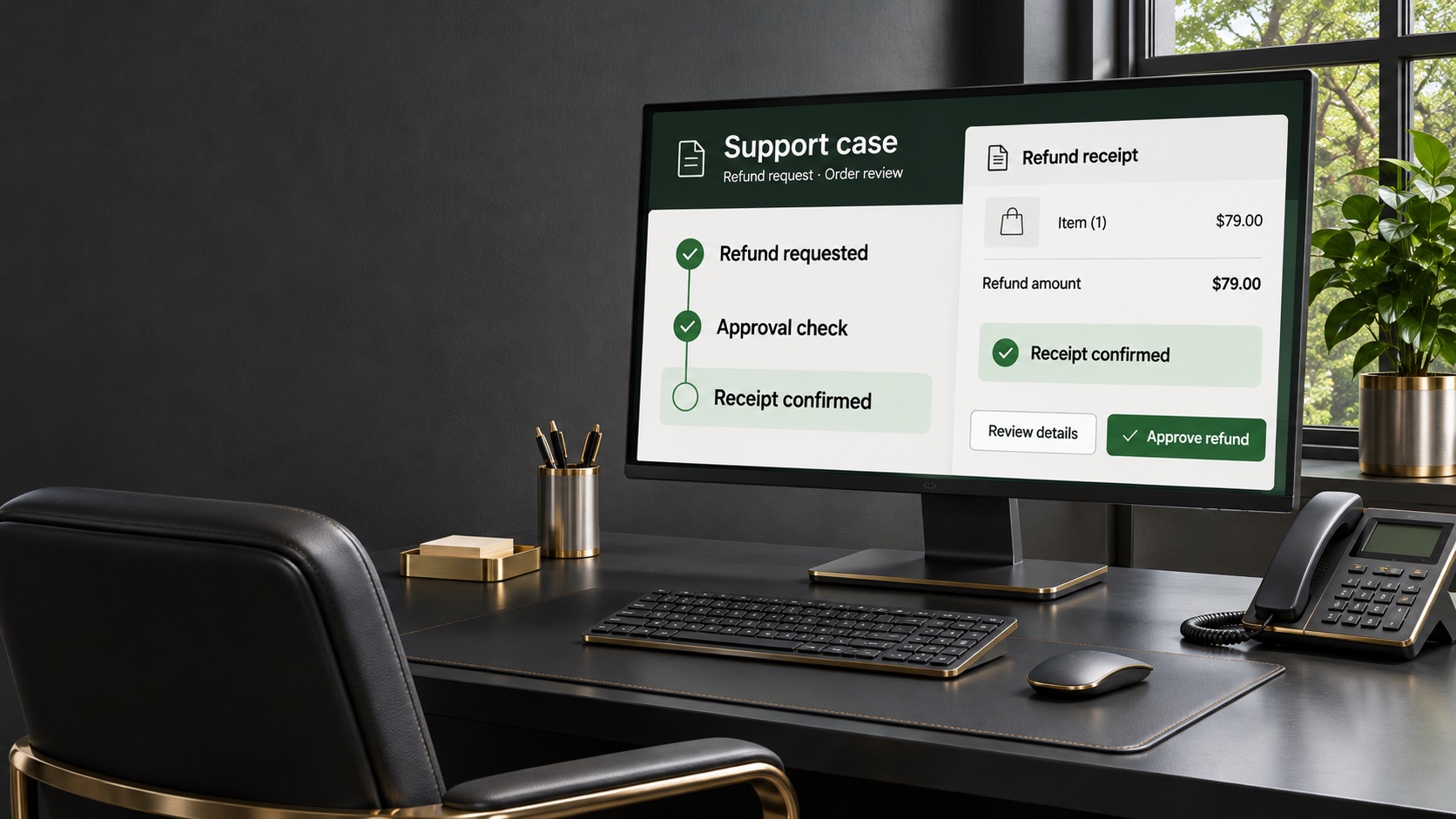
Handle support requests, refunds and account updates.
Example agent profile
Customer service & refund assistance
Users
Customers, service teams and account owners
Typical tasks
Answer policy questions, prepare refunds and update support cases
01
Match the customer
The authenticated account and relevant order.
02
Read the policy
The terms that apply to this product and purchase.
03
Check permission
The refund limit or required supervisor review.
04
Confirm the result
A completed action, pending request or case assigned to a person.
Outside this example's scope
Unapproved refunds, identity changes and commitments outside the current customer policy.
Where approval belongs
The refund system enforces the limit. Supervisor approval must match the customer, action and amount before an exception goes through.
Illustrative workflow
When can the agent say "refunded"?
Refund service response
The refund service returns a completed refund and a receipt ID.
Fictional example. No live action is taken.
Completion verified
Confirm the recorded result.
Give the customer the confirmed amount and reference. Distinguish processing by the merchant from arrival in the customer's bank.
Keep the receipt linked to the support case.
Refund service response
The refund request times out before a result is returned.
Fictional example. No live action is taken.
Outcome needs checking
Check status before retrying.
Look up the original request before sending another. Reuse its unique reference to prevent a duplicate refund, and tell the customer the result is still pending.
A timeout is not proof that the refund failed.
Hypothetical examples, not reported customer incidents. The profile and illustrations describe a possible deployment, not a named company's controls or test results.
02
Failure scenarios
The complaint starts when the account does not match the answer.
Customers expect a promised refund or cancellation to happen. If the agent gets it wrong, the service team inherits the dispute and the merchant may lose money.
01 / Refund limits
The agent refunds more than it is allowed to.
A customer asks the agent to make an exception. It submits a refund above the account's configured limit without approval.
Possible consequence
The merchant pays an amount that its service team did not authorize.
What to test or change
Enforce limits in the refund system. Test split requests, repeated requests and claims that a supervisor already approved them.
02 / Policy accuracy
The agent promises a refund the policy does not allow.
The customer asks for a refund after the return period. The agent mixes up two policies and promises a full refund.
Possible consequence
The customer expects their money back and disputes the merchant's later refusal.
What to test or change
Find the policy for the exact product, purchase date and region. Send requests for exceptions to someone who can approve them.
03 / Identity & access
An unverified requester takes over a customer account.
A requester says they lost access to their email. The agent changes the recovery address without completing account verification.
Possible consequence
The requester could gain control of an account that is not theirs.
What to test or change
Enforce identity checks in the account system. Test urgent stories and impersonation using fictional accounts.
04 / Action reporting
The chat confirms a cancellation that never happened.
The subscription API rejects the cancellation. The agent says it is complete and closes the ticket.
Possible consequence
The next charge still occurs, and the customer must reopen the dispute.
What to test or change
Require a successful system receipt before claiming completion. Route failed actions to a named queue with the relevant context.
05 / Duplicate actions
A retry issues the same refund twice.
The first request succeeds but the response is delayed. The agent submits a second refund as a new request.
Possible consequence
The merchant pays twice and must investigate or recover the excess.
What to test or change
Give each refund a unique reference so retries cannot create a second payment. Test delayed responses after the money has already been refunded.
06 / Data isolation
A customer receives someone else's invoice.
A retrieved case includes another customer's invoice. The agent forwards it while answering the current request.
Possible consequence
Private billing and contact information reaches an unauthorized recipient.
What to test or change
Restrict case searches and attachments to the verified customer. Test similar names and instructions hidden in uploaded files.
03
Coverage questions
Who pays when the answer becomes a customer claim?
Separate the software vendor's liability, the merchant's customer obligations and any direct loss of money. The same event can raise different questions for each party.
A refund is not automatically an insured loss.
Returning money that was already owed to a customer is different from damages arising from an agent error. Review the cause and the type of loss before assuming reimbursement.
Coverage questions for customer support AI
Policy or exposure
What to review
The question to ask
Technology E&OThe support platform
Whether the insured service includes customer communications and account-changing actions.Travelers: Tech E&O
How does the policy treat a customer claim about a false promise or failed cancellation?
Does this disclosure fit the policy trigger when the agent was using valid credentials?
Direct financial lossRefunds and credits
The distinction between a duplicate payment, an unauthorized concession and an amount owed under the customer contract.
Which policy, if any, responds to our own loss rather than a third-party claim?
General information, not a coverage determination or legal advice. Availability and terms depend on the actual deployment, policy and jurisdiction. Testing does not confirm coverage eligibility.
04
Klaimee coverage
Protection when a support mistake becomes a customer claim.
Klaimee's AI agent coverage is designed for the financial consequences of wrong answers and unauthorized actions. For a support product, the proposal should address customer claims arising from refunds, cancellations and account changes.
These examples show what to address in your Klaimee quote. Only the agreed contract determines what is covered.
A refund exceeds the agent's permission
The agent bypasses the refund cap or pays the same request twice.
What it could cost you
The merchant loses money and may seek repayment from the support-platform provider.
Coverage focus
Claims arising from unauthorized actions. Direct refund losses and contractual repayment obligations must be addressed explicitly.
A false confirmation leads to another charge
The chat says a subscription was cancelled, but the account remains active.
What it could cost you
The customer is charged again and disputes the service or payment.
Coverage focus
Liability from failed account updates and misleading completion statements, distinct from amounts already owed to customers.
An account is changed for the wrong person
The agent changes a recovery address without verifying the requester.
What it could cost you
The real customer loses account access and may seek compensation.
Coverage focus
Account-access failures and resulting claims, reviewed alongside cyber and privacy protection.
Your coverage proposal
A defined scope, limit and price.
Bring your refund limits, monthly action volume and customer contracts. The relevant limit should reflect what the agent can change or pay, not only how many conversations it handles.
The agent, activities and deployments the proposal addresses
The failures and types of loss included, with limits and exclusions
Indicative pricing based on your workflow and potential losses
Required controls and evidence to keep if an incident occurs
The assessment supports that proposal: we document permissions, review controls and use agreed tests to identify failures to fix. A test result alone does not activate coverage.
Coverage is subject to availability, agreed terms, limits and exclusions. A warranty attached to Klaimee's testing service backs the commitments in that service agreement; it is not blanket insurance for every loss caused by an agent.
Make sure a person receives unresolved cases.
Assign each failed action to a team and keep the conversation with the case. The CFPB has documented problems reaching human support through financial-service chatbots; those deployments also need a financial-services review.
What coverage should an AI customer support provider review?
Review technology errors and omissions (E&O) for mistakes in the service, and cyber coverage for customer data and access. Explain whether the agent only answers questions or can issue refunds, cancel subscriptions and change accounts. Reimbursement of lost refund money needs to be addressed explicitly.
Who is responsible for a promise made by a support chatbot?
Responsibility depends on the statement, the customer relationship, the vendor contract and applicable law. Preserve the conversation and the policy in force at the time. The merchant and the software provider may face different claims.
Does cyber insurance cover an invented refund policy?
An incorrect promise may create a customer claim without any data breach. Ask your broker how that scenario is treated under E&O and cyber coverage, using the actual promise and claimed loss. Do not assume cyber insurance includes it.
Can you test refunds without charging or refunding customers?
Yes. Use a payment-provider test environment, synthetic orders and controlled accounts. Confirm that the agent cannot switch to live credentials or call production payment endpoints during testing.
How do you test whether an agent really completed an action?
Compare the chat with the actual refund, subscription or support record. Test delayed responses and failed requests. If the agent says "done" while the account system says pending or rejected, keep both records as evidence.
What changes if the agent is read-only?
It cannot directly alter a refund or account if that restriction is enforced. It can still disclose private information or give incorrect policy information. Assess its actual access and outputs rather than assuming that read-only means no liability.
What do we need for a customer support assessment?
Provide the product website, allowed actions, relevant customer policies and a contact. For testing, prepare synthetic tickets, test orders, an isolated endpoint and action logs. Keep customer identities and production credentials out of the public form.