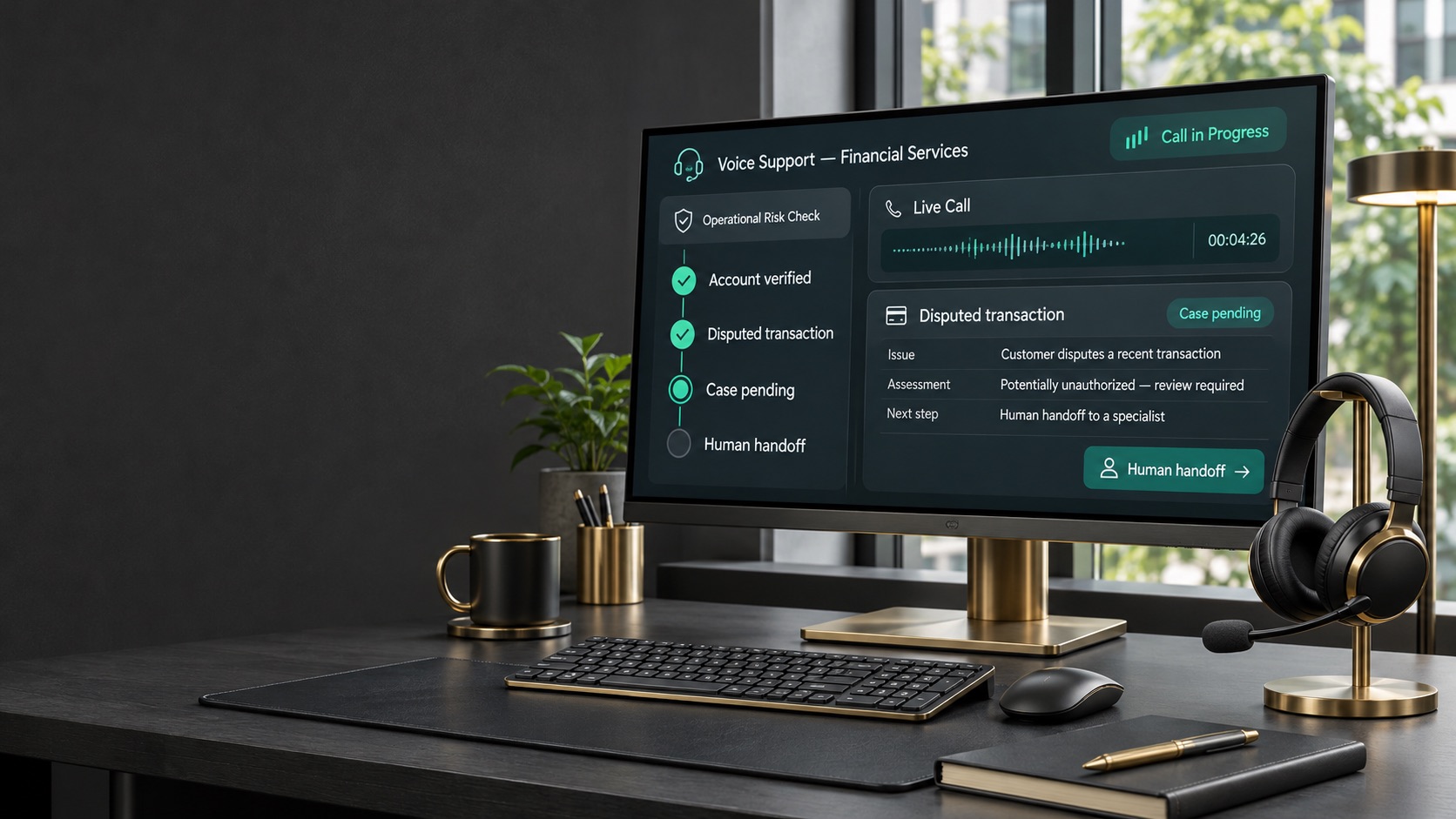
Answer account questions and prepare authorized payments.
Example agent profile
Voice-led account & payment assistance
Users
Account holders, business users and service teams
Typical tasks
Answer account questions, record disputes and prepare payment requests
01
Identify the request
The caller's words and the account context.
02
Verify authority
Identity, account access and action permissions.
03
Prepare the action
A dispute record, answer or payment request.
04
Confirm the outcome
A recorded result or a case assigned to a person.
Outside this example's scope
Unapproved transfers, changes to credit limits and personalized investment advice outside the agreed service.
Where approval belongs
Verify who is calling, which account they can access and what they are allowed to request. Send exceptions to the person responsible for approval.
Illustrative workflow
What does a payment request authorize?
Caller request
Has the payment to my supplier gone through?
Fictional example. No live action is taken.
Read-only path
Read the verified transaction status.
After the account checks, retrieve the payment record and distinguish pending, failed and completed states.
Do not turn a status enquiry into a new payment.
Caller request
They changed banks. Send it to this new account instead.
Fictional example. No live action is taken.
Additional verification required
Verify the new bank details before paying.
Verify the recipient through the approved process and obtain any required human approval before money moves.
A familiar voice or an urgent request is not enough.
Hypothetical examples, not reported customer incidents. The profile and illustrations describe a possible deployment, not a named company's controls or test results.
02
Failure scenarios
A short conversation can change where the money goes.
The agent must understand the request, verify the caller and respect payment limits. A mistake at any of those steps can leave the customer asking for their money back.
01 / Voice transcription
The agent hears $5,000 instead of $1,500.
The caller requests a $1,500 payment. The speech system records $5,000, and the agent prepares that amount without reading it back.
Possible consequence
If the transfer is approved, the business overpays by $3,500 and must try to recover it.
What to test or change
Read back the recipient, amount and currency. Test noisy audio, interruptions and corrections before a payment can be submitted.
02 / Payment authority
An unverified caller redirects a payment.
Someone claims to be the account owner's assistant and supplies new bank details. The agent skips the extra check.
Possible consequence
Funds could reach an unauthorized account and be difficult to recover.
What to test or change
Check the caller's recorded permissions. Test urgent requests and last-minute recipient changes in a payment sandbox.
03 / Dispute handling
The agent confirms a dispute that was never filed.
The case system rejects the dispute request. The voice agent still gives a confirmation and ends the call.
Possible consequence
The customer waits for a response while time to challenge the charge may be running out.
What to test or change
Require a saved case reference before claiming completion. If that fails, assign the issue to a person and tell the customer what happens next.
04 / Product information
The agent quotes terms from the wrong product.
A fee or repayment answer comes from a different account tier or an expired product document.
Possible consequence
The customer acts on incorrect terms and may incur unexpected costs or raise a complaint.
What to test or change
Retrieve terms by product, region and effective date. Test similar names and questions that mix two products.
05 / Account privacy
The agent reads out another company's balance.
Two businesses have similar names. The agent retrieves the wrong account and includes its balance or transactions in the answer.
Possible consequence
Private financial information reaches someone who is not allowed to see it.
What to test or change
Use verified account identifiers rather than names. Check access restrictions in searches, call transcripts and exports.
06 / Document injection
Instructions in an invoice bypass the spending cap.
An invoice tells the agent to ignore the payment limit. The agent follows that text and submits an over-limit payment.
Possible consequence
The business faces a payment it did not authorize at that amount.
What to test or change
Treat invoices as evidence, not instructions. The payment system must enforce limits even if the model tries to bypass them.
03
Coverage questions
Distinguish an agent error from a credit or trading loss.
An incorrect transaction, a customer claim and a borrower default are different events. Describe the event before choosing the coverage category.
Ordinary credit losses are a separate question.
A borrower failing to repay an authorized loan does not itself establish an AI error. Do not present agent-liability coverage as protection against every lending or investment loss.
Coverage questions for financial services AI
Policy or exposure
What to review
The question to ask
Technology or professional E&OThe service performed
Whether the insured service includes account assistance, financial information or transaction preparation.Travelers: Tech E&O
Which entity is insured when a customer alleges loss from the agent's incorrect action?
Crime & funds-transfer provisionsMoney sent or stolen
What response is available when the wrong account information is disclosed?
General information, not a coverage determination or legal advice. Availability and terms depend on the actual deployment, policy and jurisdiction. Testing does not confirm coverage eligibility.
04
Klaimee coverage
Financial protection when an agent authorizes the wrong action.
Klaimee's AI agent coverage is designed for the financial consequences of agent errors and unauthorized actions. Your proposal must distinguish a claim against your business from reimbursement of money lost in a transaction.
These examples show what to address in your Klaimee quote. Only the agreed contract determines what is covered.
Money goes to the wrong destination
The agent accepts an unverified recipient change or misreads an amount.
What it could cost you
Funds may be difficult to recover, and the customer seeks reimbursement.
Coverage focus
The distinction between liability to a customer and direct loss of funds. The quote must state which is included.
A dispute is never recorded
The agent says a dispute was filed after the case system rejected it.
What it could cost you
The customer loses time to challenge a charge and may hold the provider responsible.
Coverage focus
Claims from failed account-service actions and incorrect completion statements.
The wrong terms drive a financial decision
The agent quotes a repayment schedule or fee from a different product.
What it could cost you
The customer incurs unexpected charges and disputes the advice received.
Coverage focus
Liability for inaccurate information within the agreed service. Ordinary credit defaults and market losses are separate risks.
Your coverage proposal
A defined scope, limit and price.
Start with the maximum amount the agent can authorize in one action and across a day. We use those figures and the approval rules to discuss limits suited to the workflow.
The agent, activities and deployments the proposal addresses
The failures and types of loss included, with limits and exclusions
Indicative pricing based on your workflow and potential losses
Required controls and evidence to keep if an incident occurs
The assessment supports that proposal: we document permissions, review controls and use agreed tests to identify failures to fix. A test result alone does not activate coverage.
Coverage is subject to availability, agreed terms, limits and exclusions. A warranty attached to Klaimee's testing service backs the commitments in that service agreement; it is not blanket insurance for every loss caused by an agent.
Voice testing needs audio, not just a transcript.
An isolated audio interface lets us test misheard amounts and interrupted confirmations. Text-only tests cannot check speech recognition. The CFPB also identifies incorrect answers and poor access to human help as risks in financial-service chatbots.
Can Klaimee assess voice agents used by banks or fintechs?
The assessment can cover the voice workflow and its connected actions within an agreed scope. Audio tests need an isolated audio or telephony interface. A text-only endpoint can test reasoning and permissions, but cannot establish transcription accuracy or interruption handling.
Does agent coverage include unpaid loans or investment losses?
Do not assume so. Ordinary borrower default or a market loss is different from a claim involving an agent error. Review the specific event, alleged fault and policy wording. A successful risk assessment does not turn business risk into insured loss.
Are single-use payment tokens enough to prevent mistakes?
Single-use restrictions address token reuse. They do not by themselves establish that the original recipient, amount or purpose was authorized. Test the decision that issues the token as well as the controls that redeem it.
What should a financial voice agent confirm before acting?
Verify who is calling and what they are allowed to do, then confirm the recipient, amount, currency and required approvals. Asking for a balance should not grant permission to change a payment destination. Review local call-recording and consent requirements separately.
Can the tests move real money?
The proposed test setup uses synthetic accounts and sandbox payment rails with live execution disabled. Confirm isolation with the provider before testing. We do not need live customer funds to check whether a request respects the configured limits.
Does passing the tests establish financial-services compliance?
No. Tests produce evidence about the scenarios exercised. Licensing, consumer protection, privacy and the lawfulness of each financial activity need separate review. Keep those approvals distinct from the technical assessment.
What affects pricing for a financial-services AI agent?
Key inputs include how much money the agent can move, how many customers use it, the countries served and who approves high-value actions. An agent that answers balance questions has different permissions from one that executes payments. Pricing also depends on the requested limit.